
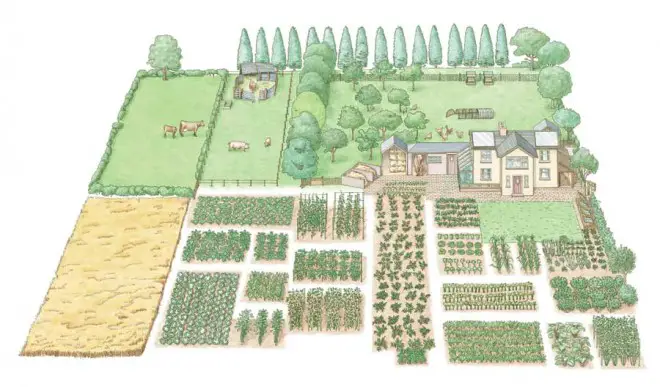
Expert advice on how to establish self-sufficient food production, including guidance on crop rotations, raising livestock and grazing management. Your 1-acre homestead can be divided into land for raising livestock and a garden for raising fruits, vegetables, plus some grain and forage crops. Illustration by: Dorling Kindersley
Everyone will have a different approach to keeping a self-sufficient homestead, and it’s unlikely that any two1-acre farms will follow the same plan or methods or agree completely on how to homestead. Some people like cows; other people are afraid of them. Some people like goats; other people cannot keep them out of the garden. Some people will not slaughter animals and have to sell their surplus stock off to people who will kill them; others will not sell surplus stock off at all because they know that the animals will be killed; and still others will slaughter their own animals to provide their family with healthy meat.
For myself, on a 1-acre farm of good, well-drained land, I would keep a cow and a goat, a few pigs and maybe a dozen hens. The goat would provide me with milk when the cow was dry. I might keep two or more goats, in fact. I would have the dairy cow (a Jersey) to provide the pigs and me with milk. More importantly, I would keep her to provide heaps and heaps of lovely cow manure to increase my soil fertility, for in order to derive any sort of living from that 1 acre without the application of a lot of artificial fertilizer, it would have to be heavily manured.
RAISING A DAIRY COW
Cow or no cow? The pros and cons are many and various for a self-sufficient homestead. In favor of raising a cow is the fact that nothing keeps the health of a family — and a farm — at a high level better than a dairy cow. If you and your children have ample good, fresh, unpasteurized, unadulterated dairy products, you will be well-positioned to be a healthy family. If your pigs and poultry get their share of the milk by-products, especially whey, they likely will be healthy, too. If your garden gets plenty of cow manure, your soil fertility will continuously increase, along with your yields.
On the other hand, the food that you buy in for this family cow will cost you hundreds of dollars each year. Compared with how much money you would spend on dairy products each year, the fresh milk supply from the cow plus the increased value of the eggs, poultry and pig meat that you will get, along with your ever-growing soil fertility, will quickly make a family cow a worthwhile investment. But a serious counter-consideration is that you will have to take on the responsibility of milking a cow. (For different milking plans and estimated savings, see Keep a Family Cow and Enjoy Delicious Milk, Cream, Cheese and More.) Milking a cow doesn’t take very long — perhaps eight minutes — and it’s very pleasant if you know how to do it and if she is a quiet, docile cow — but you will have to do it. Buying a dairy cow is a very important step, and you shouldn’t do it unless you do not intend to go away very much, or unless you can make arrangements for somebody else to take over your milking duties while you’re gone. So let’s plan our 1-acre farm on the assumption that we are going to keep a dairy cow.
1-ACRE FARM WITH A FAMILY COW
Half of your land would be put down to grass, leaving half an acre arable (not allowing for the land on which the house and other buildings stand). The grass half could remain permanent pasture and never be plowed up at all, or you could plan crop rotations by plowing it up, say, every four years. If you do the latter, it is best done in strips of a quarter of the half-acre so that each year you’re planting a grass, clover and herb mixture on an eighth of your acre of land. This crop rotation will result in some freshly sown pasture every year, some 2-year-old field, some 3-year-old field and some 4-year-old field, resulting in more productive land.
GRAZING MANAGEMENT
At the first sign the grass patch is suffering from overgrazing, take the cow away. The point of strip grazing (also called intensive rotational grazing) is that grass grows better and produces more if it is allowed to grow for as long as possible before being grazed or cut all the way down, and then allowed to rest again. In such intensive husbandry as we are envisaging for this self-sufficient homestead, careful grazing management will be essential.
Tether-grazing on such a small area may work better than using electric fencing. A little Jersey cow quickly gets used to being tethered and this was, indeed, the system that the breed was developed for on the island of Jersey (where they were first bred). I so unequivocally recommend a Jersey cow to the 1-acre farmer because I am convinced that, for this purpose, she is without any peer. Your half-acre of grass, when established, should provide your cow with nearly all the food she needs for the summer months. You are unlikely to get any hay from the half-acre as well, but if the grass grows faster than the cow can eat it, then you could cut some of it for hay.
INTENSIVE GARDENING
The remaining half of your homestead — the arable half — would be farmed as a highly intensivegarden. It would be divided, ideally, into four plots, around which all the annual crops that you want to grow follow each other in a strict crop rotation.
An ideal crop rotation might go something like this:
— Grass (for four years)
— Plot 1: Potatoes
— Plot 2: Legumes (pea and bean family)
— Plot 3: Brassicas (cabbage family)
— Plot 4: Root vegetables (carrots, beets, and so on)
— Grass again (for four years)
Consider the advantages of this kind of crop rotation. A quarter of your arable land will be a newly plowed-up, 4-year-old field every year, with intensely fertile soil because of the stored-up fertility of all the grass, clover and herbs that have just been plowed-in to rot with four summers’ worth of cow manure. Because your cow will be in-wintered, on bought-in hay, and treading and dunging on bought-in straw, you will have an enormous quantity of marvelous muck and cow manure to put on your arable land. All of the crop residues that you cannot consume will help feed the cow, pigs or poultry, and I would be surprised if, after following this crop rotation and grazing management plan for a few years, you didn’t find that your acre of land had increased enormously in soil fertility, and that it was producing more food for humans than many a 10-acre farm run on ordinary commercial lines.
HALF-ACRE CROP ROTATION
Some might complain that by having half your acre down to grass, you confine your gardening activities to a mere half-acre. But actually, half an acre is quite a lot, and if you garden it well, it will grow more food for you than if you were to “scratch” over a whole acre. Being under grass (and grazed and dunged) for half of its life will enormously increase the half-acre’s soil fertility. I think you will actually grow more vegetables on this plot than you would on a whole acre if you had no cow or grass break.
TIPS FOR THE SELF-SUFFICIENT HOMESTEAD
A dairy cow will not be able to stay outdoors all year. She would horribly overgraze such a small acreage. She should spend most of the winter indoors, only being turned out during the daytime in dry weather to get a little exercise and fresh air. Cows do not really benefit from being out in winter weather. Your cow would be, for the most part, better if kept inside where she would make lovely manure while feeding on the crops you grew for her in the garden. In the summer you would let her out, night and day, for as long as you find the pasture is not being overgrazed. You would probably find that your cow did not need hay at all during the summer, but she would be entirely dependent on it throughout the winter, and you could plan on having to buy her at least a ton. If you wanted to rear her yearly calf until he reached some value, you would likely need a further half-ton of hay. I have kept my cow on deep litter: The layer of straw gets turned into good manure, and I add more clean straw every day. I have milked a cow this way for years, and the perfect milk made good butter and cheese, and stored well. Although more labor-intensive, you could keep your cow on a concrete floor instead (insulated if possible), and giver her a good bed of straw every day. You would remove the soiled straw daily, and carefully pile it into a muck heap that would be your fount of fertility for everything on your acre.
Pigs would have to be confined in a house for at least part of the year (and you would need to provide straw for them), because, on a 1-acre farm, you are unlikely to have enough fresh land to keep them healthy. The best option would be a movable house with a strong movable fence outside it, but you could have a permanent pigpen instead.
The pigs would have a lot of outdoor work to do: They would spend part of their time plowing up your eighth of an acre of grassland, and they could run over your cultivated land after you have harvested your crops. They could only do this if you had time to let them do it, as sometimes you would be in too much of a hurry to get the next crop in. As for food, you would have to buy in some wheat, barley or corn. This, supplemented with the skim milk and whey you would have from your dairy cow, plus a share of the garden produce and such specially grown fodder crops as you could spare the land for, would keep them excellently.
If you could find a neighbor who would let you use a boar, I recommend that you keep a sow and breed her. She could give you 20 piglets a year, two or three of which you could keep to fatten for your bacon and ham supply. The rest you could sell as weanlings (piglets eight to 12 weeks old), and they would probably bring in enough money to pay for the food you had to buy for all your other livestock. If you could not get the service of a boar, you could always buy weanlings yourself — just enough for your own use — and fatten them.
Poultry could be kept in a permanent house in one corner of your garden, or, preferably, in mobile coops on the land, so they could be moved over the grassland and improve soil fertility with their scratching and dunging. I would not recommend keeping very many birds, as just a dozen hens should give you enough eggs for a small family with a few to occasionally sell or give away in summertime. You would have to buy a little grain for them, and in the winter some protein supplement, unless you could grow enough beans. You could try growing sunflowers, buckwheat or other food especially for them.
Goats, if kept instead of a dairy cow (or in addition to), could be managed in much the same way, however you would not have as much whey and skim milk to rear pigs and poultry on, and you would not build up the fertility of your land as quickly as you could with a cow. You would only get a fraction of the manure from goats, but on the other hand you would not have to buy nearly as much hay and straw — perhaps not any. For a farmer wanting to have a completely self-sufficient homestead on 1 acre, dairy goats are a good option.
Crops would be all of the ordinary garden crops (fruits and vegetables), plus as much land as you could spare for fodder crops for animals. Bear in mind that practically any garden crop that you grew for yourself would be good for the animals too, so any surplus crops would go to them. You would not need a compost pile — your animals could be your compost pile.
Half an acre, farmed as a garden with wheat grown in the other half-acre, is worth a try if you kept no animals at all, or maybe only some poultry. You would then practice a crop rotation as described above, but substitute wheat for the grass and clover field. If you are a vegetarian, this may be quite a good solution. But you could not hope to increase the soil fertility, and therefore the productiveness, of your land as much as with animals.
http://themindunleashed.org/2014/04/sta ... stead.html


