Foraging books

Read something good? Written something good? Link it, or copy it here!
Frnc
Posts: 5063
Joined: Sat Mar 12, 2022 1:54 pm

Re: Foraging books

Post by Frnc »

steptoe wrote: Sun Sep 18, 2022 1:39 pm I would say if you are going foraging for MUSHROOMS books are ok but there are a few very very POISONUS ones that minic the edibles and they can be hard to tell until you have a trained eye , if you do go either take someone who knows or be very careful if in doubt throw it out s the rule , unless you can be 100% sure you got an eater do not risk it some may just give you a bit of belly ache through to the runs and a little worse but others can kill in a flash and not even paramedics with all the drugs in the world can save you from some of them .

Nice to forage but do it very carefully

Watch the river cottage episode where huge and john take afriend each and have to collect the most varied items to make a meal watch when huge shows john the basket of mushrooms and john points out thet the ones huge thinks are good are poisonus
Yeah definitely. I aim to self train, but I think it will take years. I only intend to eat them in a survival situation. I might go on some courses eventually. I have a few books including Bon Marcel and the 2 volume Fungi of Temperate Europe, 1600 pages, also River Cottage and Wild Food UK.
Anyway, what I wanted to say was, I've heard of poisonings where someone ID'd a fungi correctly, picked a few, but one of the lookalikes was lurking among them. You have to examine every one. Some lookalikes grow in different seasons, eg Velvet Shank and Funeral Bell, but if it's a mild winter they could overlap.
And you need to use multiple sources, eg 2 or 3 decent books. Bon and FTE use keys so you can ID from scratch. Bon is out of print and expensive but I picked up a copy dead cheap, mispriced obviously. FTE is about £100 list.
Spore prints and a good loupe or two are pretty essential, I'm not sure about a microscope.
jansman
Posts: 13692
Joined: Thu Dec 30, 2010 7:16 pm

Re: Foraging books

Post by jansman »

I would want ( if I knew little about fungus) to be using foraged mushrooms regularly, knowing where they grow regularly etc. Not just when it was a ‘survival’ situation.

I know where and roughly when certain mushrooms grow locally every year.
In three words I can sum up everything I have learned about life: It goes on.

Robert Frost.

Covid 19: After that level of weirdness ,any situation is certainly possible.

Me.
Frnc
Posts: 5063
Joined: Sat Mar 12, 2022 1:54 pm

Re: Foraging books

Post by Frnc »

jansman wrote: Sun Sep 18, 2022 4:58 pm I would want ( if I knew little about fungus) to be using foraged mushrooms regularly, knowing where they grow regularly etc. Not just when it was a ‘survival’ situation.

I know where and roughly when certain mushrooms grow locally every year.
I might do. I'm just taking it one step at a time. First reading up, now I'm about to start going out looking for some. It's as much a hobby as a survival thing. Any I find I'll record when and where, and try to get a 100% ID. As for eating any, maybe that will happen eventually.

Looking at your list and my notes...
Choice = Shroomify Choice Edible
'XXX common' = rank in number of UK observations NBN database, ie Parasols are 250th most common.

Parasols 250 common, Choice
Horse mushrooms, 350 common, Choice
Field Blewitts 503 common "but may be locally abundant", Choice, no. 8 in WFUK's 10 Safest-fungi
Wood Blewitts 43rd most common, Choice
puffballs, what kinds? Giant are in top 10 safest (no. 1), 311 common
Chicken in the woods, 229 most common, Choice

I'd say you are very lucky getting all these. Only one is in the 100 most common UK fungi observations. And all but Giant Puffballs are Choice. Incidentally Shroomify gives different rank for number of observations, must use a different database.

Some safety notes from WFUK:
Puffballs; small white puffballs can resemble Amanita eggs. Always cut your puffballs in half and make sure there isn’t a little mushroom inside to be sure you don’t have an Amanita.

Young Field Mushrooms or other Agarics; if you pick a young Agaric before the cap has opened then you are running the risk of it being an Amanita. Check the colour of the gills, with the Amanitas they will always be white and with young Agarics they will always be off-white to pink.

Russulas; the Gemmed Amanita can look like the Common Yellow Russula if all of the speckles have been washed off the top. Check the shape and texture of the stem. The Russula stem will be straight and white like a stick of chalk and have no skirt. The Amanita stem will be bulbous at the base and probably have a skirt.

Parasols; there are a number of superficial similarities between the Parasol and the Amanita family. Check the cap of your Parasol to make sure it actually has true scales, rather than having scale-like deposits that you can brush off. Also check the skirt on the stem as this can be moved up and down on Parasols.
There's also a bit about edible amamitas, not even going there!
Frnc
Posts: 5063
Joined: Sat Mar 12, 2022 1:54 pm

Re: Foraging books

Post by Frnc »

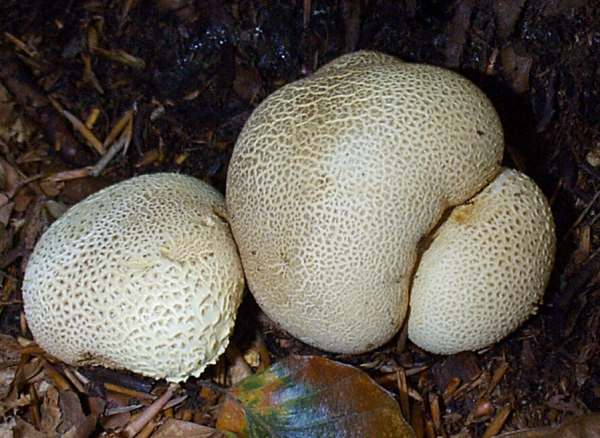
Some notes I was just reading re Earthballs (toxic, and common (21))
https://www.first-nature.com/fungi/scle ... trinum.php
Earthballs are much less spongy than the various puffballs with which they are sometimes confused.
Lycoperdon perlatum, the common puffball, has pearly, pointed scales and is very spongy to the touch. It is club-like in shape has a rudimentary infertile stipe.
Lycoperdon mammiforme, another of the many puffball species, is white at first before its surface breaks up into large cream scales rather than warts; it, too, is more spongy and is more pear shaped, comprising a fertile ball on a spongy infertile stipe.
Inside the earthball the spore mass is almost white at first but soon turns brown with white marbling before becoming purple-brown throughout.
Image
WFUK says " When very young the interior of the mushroom can appear whitish or slightly pink/purple but is never pure white like a Puff Ball. When mature the interior becomes powdery and the outer skin will develop pores or splits through which the spores can be distributed when the mushroom is disturbed or rained on."
Also in the comments about possible danger of breathing in the power.
GeoffDann
Posts: 8
Joined: Fri Oct 24, 2025 11:06 am

Re: Foraging books

Post by GeoffDann »

jansman wrote: Sun Sep 18, 2022 3:06 pm yesterday I found a real rare one - Chicken in the woods.
COTW is very common throughout the UK.
Current main website: https://www.ecocivilisation-diaries.net/
Free text of book "The Real Paths to Ecocivilisation": https://ecocivilisation.net/ecocivilisation/
Peter
Posts: 281
Joined: Wed Mar 01, 2023 4:21 pm
Location: West Midlands

Re: Foraging books

Post by Peter »

Fungi looks to me to be a lottery, and i’m not a gambling man.

I will stick to using Richard Mabey’s book “Food For Free” for foraging.
GeoffDann
Posts: 8
Joined: Fri Oct 24, 2025 11:06 am

Re: Foraging books

Post by GeoffDann »

Peter wrote: Fri Oct 24, 2025 5:53 pm
It is not a lottery. You just have to know what you are doing. Start with the easy stuff and leave the more dangerous stuff until you are more experienced.

I've eaten over 300 different species of wild fungi. I've had digestive problems more than once, but in each case I knew I was at zero risk of long-term harm. There's not that many deadly species. In fact, every single fatality in the UK since modern medicine existed has been caused by a single species (the Deathcap). And there really isn't any excuse not to recognise one of those if you come across one.
Current main website: https://www.ecocivilisation-diaries.net/
Free text of book "The Real Paths to Ecocivilisation": https://ecocivilisation.net/ecocivilisation/
Frnc
Posts: 5063
Joined: Sat Mar 12, 2022 1:54 pm

Re: Foraging books

Post by Frnc »

GeoffDann wrote: Sat Oct 25, 2025 7:30 am
Peter wrote: Fri Oct 24, 2025 5:53 pm
It is not a lottery. You just have to know what you are doing. Start with the easy stuff and leave the more dangerous stuff until you are more experienced.

I've eaten over 300 different species of wild fungi. I've had digestive problems more than once, but in each case I knew I was at zero risk of long-term harm. There's not that many deadly species. In fact, every single fatality in the UK since modern medicine existed has been caused by a single species (the Deathcap). And there really isn't any excuse not to recognise one of those if you come across one.
How do you actually find the fungi? I've walked through plenty of woods, but I don't remember ever seeing any.
GeoffDann
Posts: 8
Joined: Fri Oct 24, 2025 11:06 am

Re: Foraging books

Post by GeoffDann »

Frnc wrote: Sat Oct 25, 2025 1:31 pm How do you actually find the fungi? I've walked through plenty of woods, but I don't remember ever seeing any.
It took me 6 years to find all the fungi I photographed in Edible Mushrooms. I walked thousands of miles, also went on a fungi-hunting holiday to Scotland and was working as a foraging teacher at various locations all over England. I didn't just need to find them all -- I needed to find them in the right conditions (both fungi and weather) for getting the correct photos.

You need to be in the right place at the right time.
Current main website: https://www.ecocivilisation-diaries.net/
Free text of book "The Real Paths to Ecocivilisation": https://ecocivilisation.net/ecocivilisation/
grenfell
Posts: 4425
Joined: Thu Jul 04, 2013 7:55 pm

Re: Foraging books

Post by grenfell »

GeoffDann wrote: Sat Oct 25, 2025 3:22 pm
You need to be in the right place at the right time.
That's very true, there have been times I've walked fields and barely seen a mushroom but other times there have been an abundance. Probably the best place was when I worked at Battlefield church in Shrewsbury , a five minute walk and I'd found the old dependable field mushroom , puffballs , parasolls blewits and numerous others...
As a kid though I was taught never to touch wild mushrooms despite living a more rural based life my parents were very very wary of them and would often stamp on them to prevent anyone picking them. Looking back I don't really understand it but that's just the way they were...